Top Server GPU Cards of 2025: Best Options for High-Performance Computing
In the rapidly evolving landscape of high-performance computing, the significance of advanced Server GPU Cards cannot be overstated. As industries increasingly turn to data-intensive applications such as artificial intelligence, machine learning, and complex simulations, the demand for robust and efficient GPU solutions is paramount. Renowned expert in the field, Dr. Amelia Chen, a leading researcher at the Global Institute of Technologies, states, "The next generation of Server GPU Cards will not only enhance computational power but will also drive innovations across various sectors by enabling faster processing and real-time data analysis."
As we look towards 2025, the market is poised to unveil an impressive array of Server GPU Cards that promise to transform the computing paradigm. With advancements in architecture, memory bandwidth, and energy efficiency, these GPUs will play a critical role in supporting the increasing computational demands of modern applications. This article explores the top contenders in the Server GPU Cards arena, examining their specifications, performance benchmarks, and potential impacts on the future of high-performance computing. By leveraging the expertise of industry professionals and latest technological insights, we aim to provide a comprehensive guide for businesses and tech enthusiasts aiming to invest in these powerful computing tools.

Overview of High-Performance Computing and Its Importance in 2025
High-performance computing (HPC) is set to play a pivotal role in various sectors, reflecting its dramatic growth forecasted for 2025. With the global HPC market expected to reach $57.98 billion, driven by rapid advancements in artificial intelligence, machine learning, and big data analytics, organizations across industries are increasingly relying on powerful computational tools to derive insights and make informed decisions. This growth highlights the essential nature of HPC in tackling complex problems and facilitating innovation in fields such as scientific research, financial modeling, and climate simulation.
As the demand for computational resources escalates, the importance of investing in high-performance server GPU cards cannot be overstated. These specialized hardware components are crucial for delivering the necessary processing power, enabling efficient data handling, and accelerating application performance. The evolution of HPC technologies signifies a transformative shift in how companies and research institutions operate, empowering them to push the boundaries of what is possible in their respective domains. With a compound annual growth rate of
10.3% anticipated through 2035, the HPC sector represents a significant investment opportunity and a catalyst for future breakthroughs.
Key Features to Look for in Server GPU Cards for Optimal Performance
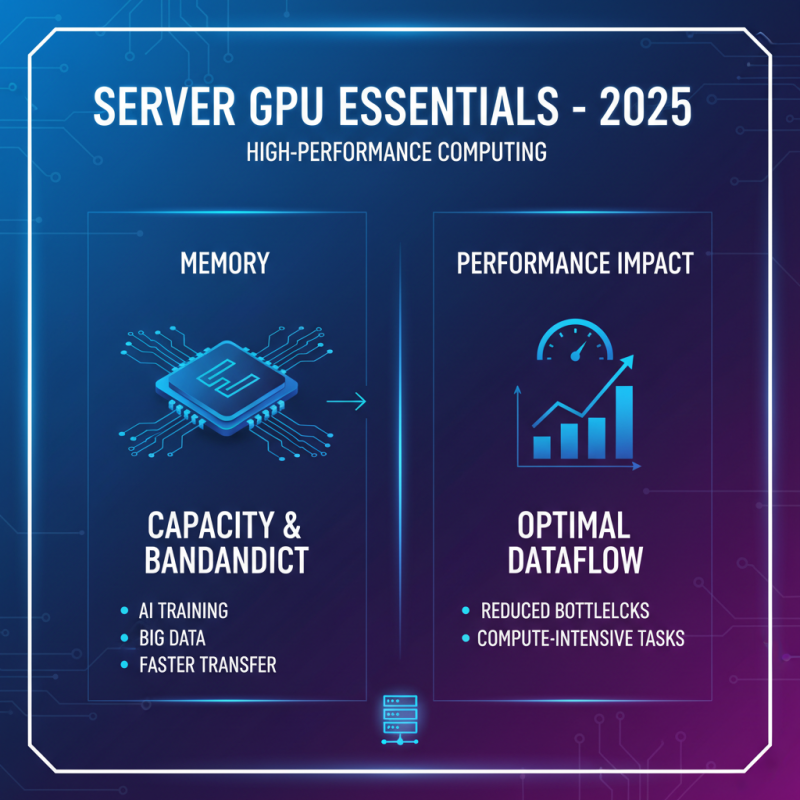
When selecting server GPU cards for high-performance computing in 2025, several key features are essential for ensuring optimal performance. Firstly, memory capacity and bandwidth are critical. High-performance applications, such as AI training and real-time data processing, benefit from GPUs with larger memory sizes, allowing them to handle more significant datasets efficiently. A higher memory bandwidth can reduce bottlenecks, enabling faster data transfer between the GPU and memory, which is pivotal for compute-intensive tasks.
Additionally, thermal management and power efficiency have become increasingly important, particularly in data center environments. Advanced cooling solutions and lower thermal design power (TDP) can help maintain performance stability under heavy loads while reducing operational costs. Furthermore, support for modern interconnect technologies, such as NVLink or PCIe 4.0/5.0, is vital for maximizing the performance of multi-GPU deployments. These features ensure that GPUs can work together seamlessly, enhancing the overall computational power available for demanding applications.
Top Server GPU Cards of 2025: Analyzing Market Leaders and Innovations
The server GPU market is evolving rapidly, with innovations driving performance and efficiency to meet the demands of high-performance computing (HPC). A recent report from IDC predicts that the global GPU market will reach $165 billion by 2025, fueled by the rising demand for AI applications and data analytics. Companies like NVIDIA and AMD are leading the way, introducing powerful GPUs designed specifically for server environments, which feature significant improvements in processing power and energy efficiency.
 In this competitive landscape, NVIDIA's A100 Tensor Core GPU stands out, offering 20 times the performance of previous generations for machine learning tasks. On the other hand, AMD's MI250, with its advanced packaging technology, showcases robust capabilities for data-intensive applications. These innovations not only enhance computational speed but also reduce the overall energy consumption, aligning with the industry’s growing emphasis on sustainability.
Tips: When selecting a server GPU card for your HPC needs, consider not just raw performance but also compatibility with existing infrastructure. Evaluate power consumption and cooling requirements, as these can substantially influence your total cost of ownership. Lastly, keep an eye on emerging players in the market, as new entrants may offer competitive alternatives that could better suit your specific workloads.
Benchmark Comparisons: Evaluating Server GPUs for HPC Workloads
As we look toward 2025, the landscape of server GPU cards is evolving rapidly, particularly for high-performance computing (HPC) applications. Benchmark comparisons reveal distinct differences in performance, power efficiency, and cost-effectiveness. For instance, a recent report by IDC highlights that NVIDIA's A100 GPU consistently leads in MLPerf benchmarks, showcasing superior throughput and lower latency for AI training workloads. With a remarkable performance per watt of 20.3 TFLOPS for FP16 processing, the A100 exemplifies what is needed for demanding data centers.
In comparison, AMD's MI250X is gaining traction, particularly in mixed-precision workloads, according to a study published by Jon Peddie Research. It delivers up to 47.7 TFLOPS of FP16 performance, making it a formidable contender for applications like scientific simulations and financial modeling. Additionally, the introduction of next-gen GPUs such as Intel's Falcon Shores aims to shake things up, focusing on enhanced memory bandwidth and a unique architecture that could provide an edge in future HPC benchmarks. As server managers evaluate these options, the emphasis on benchmarking will be pivotal in selecting the right GPU for specific workload requirements.
Future Trends: What to Expect in Server GPU Technology and Performance
The integration of artificial intelligence (AI) into high-performance computing (HPC) systems is set to be a major trend shaping the future landscape of technology. As AI demands increasing computational power, the synergy between AI and HPC is becoming essential for achieving unprecedented speeds and efficiencies. This convergence is driving innovations in GPU technology, with hardware specifically designed to optimize AI workloads within data centers. By enhancing the performance of these systems, organizations can leverage advanced AI algorithms to process vast amounts of data, yielding insights that were previously unattainable.
Looking ahead to 2025 and beyond, the hardware market for HPC, data centers, and AI will witness substantial transformation. Predictions indicate the data center GPU market will experience explosive growth, projected to reach significant valuations by 2035. This growth is attributed to the rising need for more powerful computation in various sectors, fueled by a surge in AI applications. With advancements in thermal management and AI chips, the focus will gradually shift towards creating more efficient and scalable data center solutions that can meet the demands of next-generation AI technologies.