How to Choose the Best Laptop Server for Your Business Needs
In today's fast-paced business environment, the demand for reliable and efficient computing solutions has never been higher. With the increasing complexity of operations and the need for robust data management, many businesses are turning to Laptop Servers as a viable option for their IT infrastructure. A Laptop Server combines the portability of a traditional laptop with the capabilities of a server, offering a unique blend of flexibility and performance. This makes it an ideal choice for businesses that require both on-the-go access and powerful processing capabilities.
Choosing the best Laptop Server for your business needs requires careful consideration of several factors, including processing power, storage capacity, connectivity options, and scalability. Each organization has its own unique requirements, and understanding these needs is crucial for making an informed decision. Whether you're a small startup looking to minimize costs or a larger enterprise in need of robust solutions, selecting the right Laptop Server can significantly impact your operational efficiency and overall productivity. In this guide, we will explore key aspects to consider when choosing a Laptop Server that aligns with your business objectives, ensuring you make a choice that meets current demands while being adaptable for future growth.

Understanding Your Business Requirements for a Laptop Server
Understanding your business requirements is crucial when selecting the best laptop server for your organization. Start by evaluating the specific tasks your business needs the server to perform. Consider the volume of data you handle daily, the types of applications you'll be running, and the number of concurrent users accessing the server. For instance, if your business requires running resource-intensive applications or managing large databases, you will need a laptop server with higher processing power and expanded memory capacity.
Additionally, assess the flexibility and portability required by your team. If employees need to access the server remotely or on-the-go, prioritize lightweight models with good battery life and robust connectivity options. Security should also be a key factor—ensure that the laptop server can support advanced encryption and access controls to protect sensitive information. By clearly understanding these diverse needs, you can streamline your selection process and choose a laptop server that aligns efficiently with your business operations and goals.
Key Features to Look for in a Laptop Server
When selecting a laptop server for your business, several key features should be prioritized to ensure it meets your specific needs. First and foremost, consider the processing power. Look for a laptop server equipped with a robust CPU that can handle multitasking and intensive applications. A multi-core processor is ideal, as it will enable the server to efficiently manage multiple requests and workloads, ultimately enhancing overall productivity.
Additionally, memory and storage capacity are crucial factors. Aim for a laptop server with ample RAM, as this will facilitate faster data access and improve performance when running server-based applications. Solid-state drives (SSDs) are also recommended for their speed and reliability, particularly when it comes to data retrieval and storage management. Furthermore, assess the expandability of the laptop server; you may need to upgrade components in the future to accommodate growing business demands.
Lastly, connectivity options should not be overlooked. Ensure the laptop server offers a variety of ports for easy connectivity with other devices, as well as strong wireless capabilities to support remote access and collaboration. Prioritizing these features will help you choose a laptop server that not only fits your current business needs but also adapts to future growth and technological advancements.
Assessing Performance Specifications for Optimal Use
When selecting the best laptop server for your business needs, assessing performance specifications is crucial for ensuring optimal use.
Start by evaluating the processor. Look for a powerful CPU that can handle multiple tasks efficiently, particularly if your business relies on resource-intensive applications or data processing. An advanced multi-core processor can significantly enhance performance, enabling smoother operation under heavy workloads.
Next, consider the RAM capacity, as it directly influences the server's ability to multitask. A minimum of 16GB is recommended, but depending on the size of your operations, you may need to opt for 32GB or more to ensure that applications run seamlessly without slowdowns. Additionally, storage type and capacity should not be overlooked; solid-state drives (SSDs) provide faster read and write speeds compared to traditional hard disk drives (HDDs), resulting in improved data retrieval times and overall efficiency.
Finally, don't ignore network capabilities, including Wi-Fi standards and Ethernet support. A robust network is essential for a server, as it directly affects data transfer speeds and overall connectivity within your business environment. By paying attention to these performance specifications, you can choose a laptop server that not only meets your current needs but also scales with your business growth.
Budgeting and Cost Considerations for Your Laptop Server
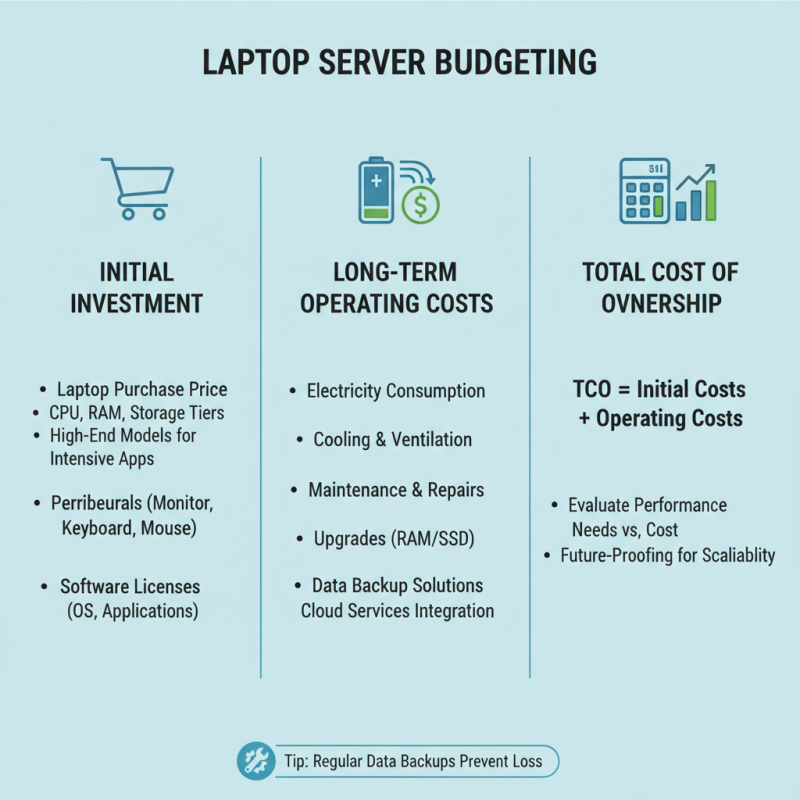
When budgeting for a laptop server, it's essential to evaluate both the initial investment and long-term operating costs. The initial purchase price can vary significantly based on the specifications you require, such as processing power, memory, and storage capacity. Businesses should consider what level of performance is crucial for their operations. For instance, if running resource-intensive applications, opting for a higher-end model may be necessary, even if it means stretching the budget slightly. Additionally, include peripherals and software licenses in your calculations to avoid unexpected expenses later on.
Long-term cost considerations often encompass maintenance, energy consumption, and potential upgrades. A laptop server will require regular updates and occasional hardware repairs, so it's wise to factor in potential costs for servicing. Moreover, the energy efficiency of the laptop server can impact operational costs—selecting models designed for lower power consumption can lead to significant savings over time. Finally, keeping an eye on future scalability is crucial. Investing now in a server that can be easily upgraded will prevent costly overhauls down the line, allowing your business to adapt and grow without outdated technology holding it back.
Evaluating Brand Reliability and Customer Support Options
When selecting a laptop server for your business needs, evaluating the
brand reliability
and customer support options is critical. Industry research indicates that
73% of businesses
cite strong customer support as a key factor in their purchasing decisions.
Reliable brands often provide extensive documentation and responsive support
services, which can help minimize downtime and ensure swift troubleshooting.
A report from IT Pro Research revealed that companies using vendors with
high customer satisfaction ratings
experienced 20% less downtime than those
who didn't prioritize support quality.
Moreover, investing in a brand known for
durability and performance
can yield significant long-term savings. According to a survey by TechRepublic,
organizations that chose well-supported laptop servers reported an average
of 15% lower maintenance costs
over five years compared to those that opted for less-reliable brands. This
demonstrates that while initial costs may be comparable, the value derived from
reliable support can vastly influence the total cost of ownership. As such,
businesses must prioritize vendors with proven track records in
reliability and customer service
when making their selections.