How to Choose the Best Enterprise Switches for Your Business?
Choosing the right enterprise switches for your business is crucial. These devices serve as the backbone of your network. They manage data traffic and ensure reliable connectivity. The right switch can improve performance and scalability.
When evaluating enterprise switches, consider your specific needs. Think about the number of devices connected, bandwidth requirements, and future growth. Not all switches are created equal. Some may offer advanced features but at a higher cost. Weighing cost against capability can be challenging.
It’s also important to look at vendor support and product reliability. Not every brand provides the same level of service. Research reviews and case studies to gain insights. Be aware that selecting enterprise switches is a decision with long-term impacts. Your network's efficiency might depend on this choice.
Factors to Consider When Selecting Enterprise Switches for Businesses
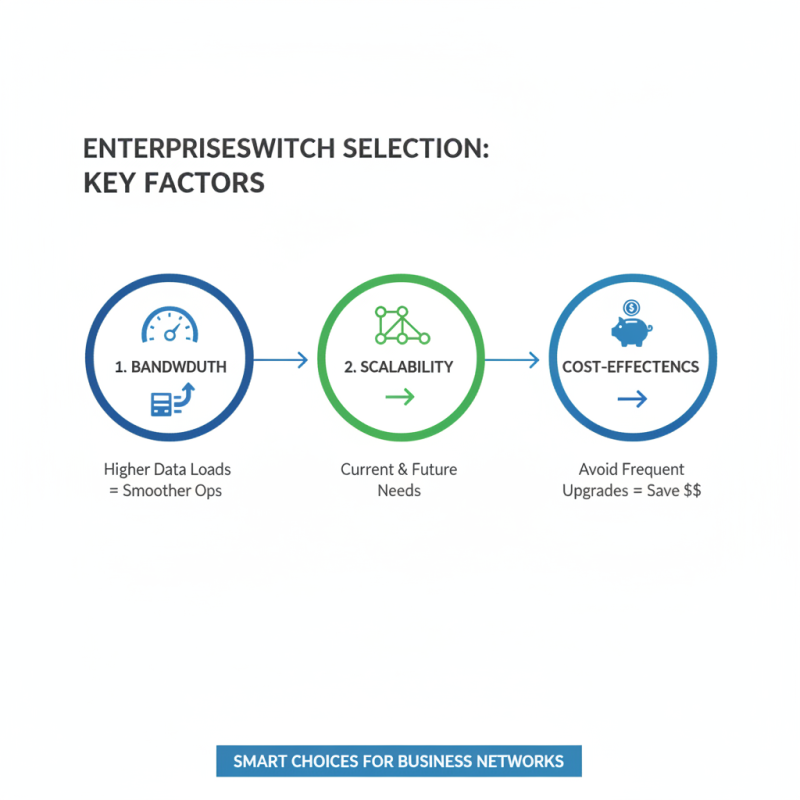
Choosing the right enterprise switch is crucial for business operations. Consider the bandwidth requirements of your network. A faster switch can handle higher data loads, making operations smoother. Evaluate your current and future needs to avoid frequent upgrades. This foresight saves time and money.
Another important factor is support for scaling. Does the switch handle growth? Look for features that allow easy expansion of connections. Consider energy efficiency as well. A switch that consumes less power can lower operating costs significantly.
Don't overlook security features. Switches with advanced security protocols protect sensitive data. Analyze ease of management, too. A user-friendly interface helps IT teams troubleshoot issues quickly. Ultimately, finding the best switch requires balancing performance, scalability, and efficiency. Reflect on these aspects regularly to refine your choice.
Understanding the Different Types of Enterprise Switches Available
When choosing enterprise switches, it's crucial to understand the different types. There are managed switches, unmanaged switches, and smart switches. Managed switches offer advanced features. They allow for greater control over the network and enable monitoring. Unmanaged switches are simpler and cheaper but lack customization options.
Tips: Assess your network needs before deciding. If you anticipate high traffic, go for managed switches. They can support various configurations. Smart switches provide a middle ground with some management features. They suit small to medium-sized businesses well.
Another consideration is port density. If your business has many devices, look for switches with higher port counts. This reduces the need for additional hardware. Remember, redundancy is key. A single point of failure can disrupt your entire network. Investing in quality switches can make a significant long-term difference. Balance between cost and capability is essential. Don't rush the decision. Take time to evaluate all options.
Choosing the Best Enterprise Switches: Comparison of Different Types
Evaluating Network Size and Scalability for Future Needs
When evaluating your network size, start by assessing current usage. How many devices are connected? Consider computers, printers, and smartphones. Map out the flow of data in your environment. This offers a clearer picture of your needs.
Next, think about scalability. Your business might grow, adding more users or devices. Choose switch solutions that can adapt to these changes. An upgrade path is crucial. It allows for expansion without major technology overhauls. A flexible design will save costs in the long run.
Lastly, consider future technologies. Will IoT devices become part of your network? Ensure your switches can handle increased traffic. Planning for these developments can help avoid bottlenecks. Pay attention to potential needs. Reflecting on these factors now will better prepare your business for growth.
How to Choose the Best Enterprise Switches for Your Business? - Evaluating Network Size and Scalability for Future Needs
| Criteria |
Description |
Importance Level |
Future Scalability |
| Port Count |
Total number of ports available for devices |
High |
Consider potential growth |
| Speed Support |
Gigabit vs. 10 Gigabit vs. higher |
Medium |
Plan for bandwidth needs |
| Layer Type |
Layer 2 vs. Layer 3 switches |
High |
Determine routing capabilities |
| Management Interface |
CLI vs. Web-based vs. SNMP |
Medium |
Ease of configuration and monitoring |
| Power over Ethernet (PoE) |
Support for powering devices |
High |
Reduce cables for devices |
| Redundancy Features |
Option for backup connections |
Medium |
Ensure minimal downtime |
Performance Metrics: Speed, Throughput, and Latency in Switch Selection
When selecting enterprise switches, performance metrics such as
speed, throughput,
and latency are crucial. A study by the IEEE indicates that networks with
higher throughput can reduce bottlenecks.
Throughput directly impacts the amount of data handled simultaneously. For example, a system
with 10 Gbps throughput can support more devices without
lag. Organizations must ensure their switches can handle heavy traffic efficiently.
Latency is another vital factor. A report from Cisco emphasizes that low latency
is key for applications requiring real-time processing.
Delays can disrupt communication in critical business operations. Ideally,
latency should be less than 1 millisecond.
However, achieving this in high-load situations can be challenging. Companies often overlook
this aspect, leading to performance issues down the line.
Speed determines the network’s capability to respond swiftly.
Switches supporting higher speeds enhance user experience. Networking research from Gartner suggests
that a shift toward 100 Gbps switches is prevalent.
But, not all organizations need such high speeds right away. It's essential to assess your
business needs and growth plans when choosing. Balancing these performance metrics is not always
straightforward but is vital for optimal network efficiency.
The Role of Managed vs Unmanaged Switches in Business Networks
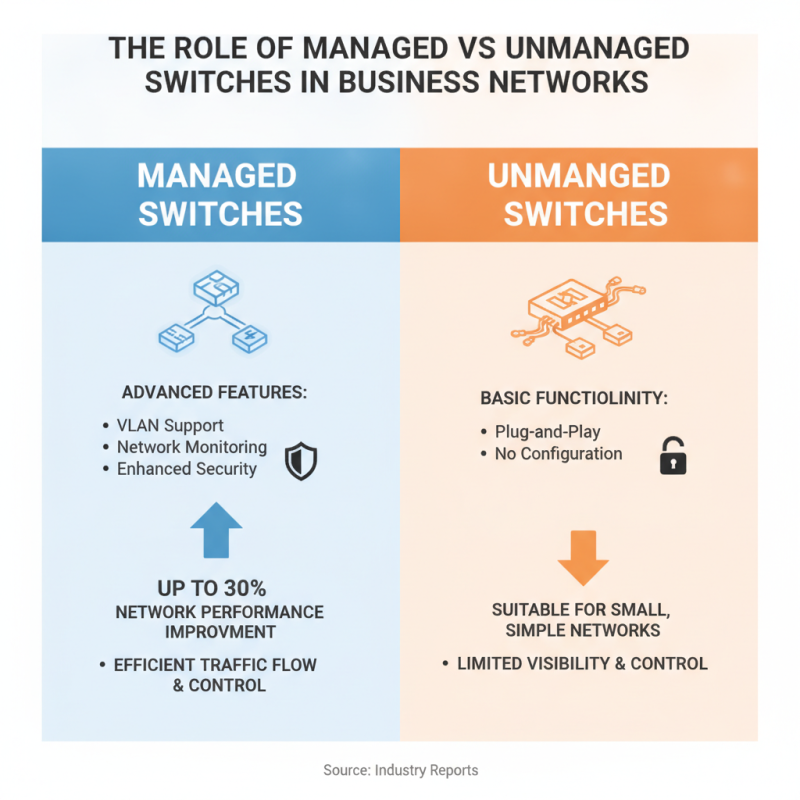
When selecting the right network switches for your business, the choice between managed and unmanaged switches is critical. Managed switches provide advanced features such as VLAN support, network monitoring, and better security. According to industry reports, organizations utilizing managed switches can see up to 30% improvement in network performance. This is because these switches allow for more efficient traffic flow and better control over connected devices.
Unmanaged switches, on the other hand, are simpler and cost-effective. They come pre-configured and are easy to set up, making them ideal for small businesses or specific applications. However, they lack the flexibility and control that managed switches offer. Research reveals that nearly 40% of businesses may underestimate their future network needs, leading to limitations with unmanaged options. This can hinder scalability as the business grows.
Ultimately, the choice between managed and unmanaged switches should reflect specific business goals and requirements. A clear assessment of networking needs is essential. Failure to do this can result in poor network performance and increased frustration among users. Balancing cost and functionality is key. Making a hasty decision without evaluating these factors can be detrimental to overall efficiency.