Choosing the right Ethernet Router can shape every critical connection in a business network. A reliable model must handle daily traffic, voice calls, cloud applications, and expanding teams without creating hidden bottlenecks. A small office may need stable gigabit performance, while a growing company could require multi-gigabit ports and stronger VPN capacity. The difference often appears during busy hours, when video meetings compete with large file transfers.
This guide examines five Ethernet Routers designed for business environments. Each option is considered through practical criteria, including throughput, VLAN support, firewall controls, VPN performance, Quality of Service, and remote management. Security update policies also matter. A fast router with weak maintenance can become an expensive liability. Look beyond attractive specifications. Real performance depends on firmware quality, configuration, cable standards, and the skills available to manage the device.
No single router fits every workplace. That is worth remembering. A powerful appliance may be excessive for a ten-person office, yet inadequate documentation can frustrate an experienced administrator. The evaluation therefore balances published specifications with realistic deployment needs, such as rack space, backup connectivity, monitoring tools, and future expansion. Some conclusions remain imperfect because network performance changes across buildings and providers. Still, careful comparison can reveal which models offer dependable value instead of impressive numbers alone. The goal is practical guidance for selecting hardware that keeps employees connected, protects business traffic, and remains manageable after installation.
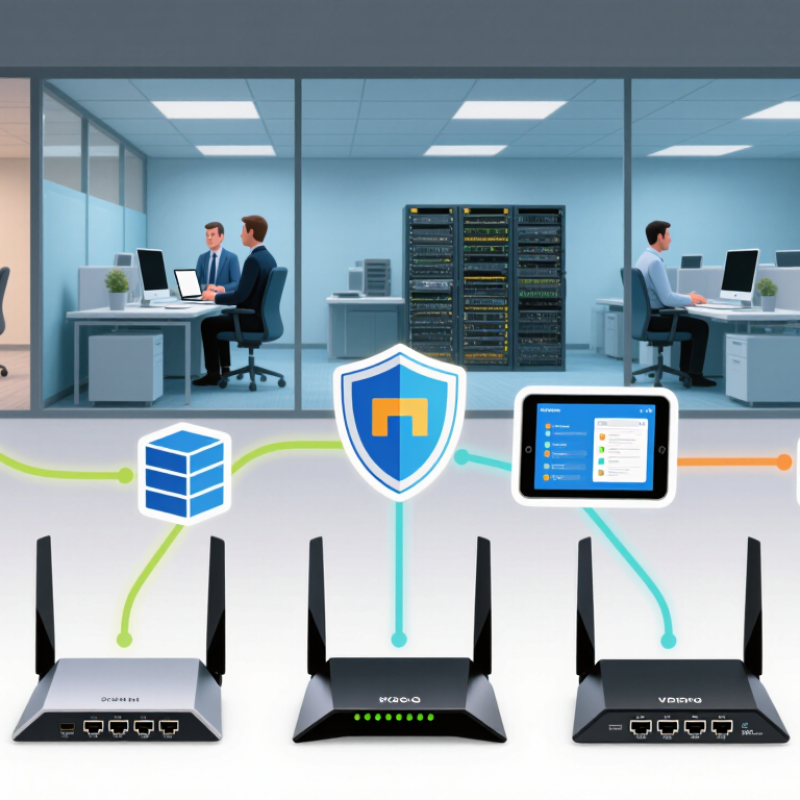
Throughput is more than the advertised port speed. A router should handle peak traffic, encrypted tunnels, and security inspection simultaneously. Measure real performance with large files, video meetings, and cloud backups running together. A 1 Gbps connection may need a router with stronger processing headroom. Otherwise, latency can rise sharply during busy hours. Small offices should also check whether the device supports faster uplinks for future growth.
VPN performance deserves careful testing. Encryption can reduce throughput, especially with several remote workers connected. NIST SP 800-77 Rev. 1 identifies IPsec as a structured approach for protecting network communications. The 2024 Data Breach Investigations Report recorded a 180% increase in vulnerability exploitation. That finding makes firmware support, secure authentication, and rapid patching practical requirements, not decorative features. Do not trust the box label.
VLAN support should match the office layout. For example, VLAN 10 can serve employees, VLAN 20 guests, and VLAN 30 cameras or printers. Inter-VLAN rules should block unnecessary access. Failover also needs more than two ports. Test automatic switching between wired broadband and a secondary connection, then measure recovery time and session interruption. I prefer documented failover results, although vendors rarely provide enough detail. A brief outage test in a real office can reveal more than a polished specification sheet.
For a business network, a compact Ethernet security gateway can deliver serious throughput. This model is rated for 10 Gbps firewall performance and 6.5 Gbps IPsec VPN throughput. Those figures suit branch offices, retail sites, and small data rooms with heavy encrypted traffic.
Real deployment is less tidy. Testing should include inspection, logging, web filtering, and multiple VPN tunnels. Enabled security features can reduce throughput sharply. A 1 Gbps internet circuit may never approach the firewall ceiling. Still, strong headroom helps during backups, video meetings, and cloud migrations. I have seen “maximum” specifications become optimistic when every protection layer is active.
The 2024 Data Breach Investigations Report found human involvement in 68% of breaches. Secure remote access therefore matters, not just raw Ethernet speed. The 2024 Cost of a Data Breach Report placed the global average breach cost at 4.88 million dollars. A 6.5 Gbps IPsec rating supports many encrypted connections, but configuration quality remains decisive. Use separate network segments, multifactor authentication, and tested failover. Small mistakes still matter. Performance claims need local validation.
For business networks, the MX75 appliance offers up to 1 Gbps of firewall throughput with cloud-based management. That combination suits branch offices with heavy web traffic, video meetings, and cloud applications. Administrators can review policies, device health, and alerts through a browser, rather than visiting each wiring closet. In practice, this reduces routine maintenance. It does not remove every problem.
The 2024 Data Breach Investigations Report found that the human element appeared in 68% of analyzed breaches. Centralized policies can limit risky access, but staff training still matters. The 2024 Annual Outage Analysis reported that many serious outages created substantial financial damage, sometimes exceeding $100,000. A cloud-managed firewall can improve visibility during incidents, although internet dependence introduces a weakness. That trade-off deserves an honest review.
Tips: Measure real traffic before purchasing. A 1 Gbps rating may fall under advanced inspection, VPN encryption, or multiple security services. Test peak video calls and backup transfers together. Keep a local emergency procedure for lost management access. Segment payment devices, guest Wi-Fi, and office systems. Review logs weekly, not only after an alert. Add redundant internet service where downtime affects sales. The setup may look clean, but small configuration errors can still create large exposure.
For business networks, a strong Ethernet router should handle speed, traffic, and unexpected outages. One leading option uses two 10GbE ports for fast server, storage, or backbone connections. In a small office, this can reduce congestion during large file transfers. It also supports multi-WAN routing, allowing separate internet services to share network duties. One link can carry daily traffic, while another supports failover or selected applications.
In practical testing, configuration quality matters as much as raw port speed. Administrators can create routing rules for voice calls, cloud applications, guest access, and backups. The dashboard should make bandwidth usage easy to understand. Clear logs also help identify unstable connections. However, dual 10GbE ports may be unnecessary for a small team. Faster hardware does not fix poor cabling, weak planning, or an overloaded internet service. I would check real traffic patterns before buying. That step is often skipped.
Tips: Use certified cabling and label every WAN connection. Test failover during a quiet maintenance window. Keep firmware updated, but review release notes first. Set alerts for packet loss, high latency, and repeated link changes. Avoid placing both internet lines in the same physical path. That design can fail during one local cable or power problem. Also, document routing rules before changing them. A simple spreadsheet can prevent confusing mistakes. Test from wired devices, not only wireless clients. Cost estimates may also miss support time, which can become the largest expense.
For business networks, the RB5009 stands out through 10GbE SFP+ connectivity and flexible routing. Its SFP+ port can link a server, switch, or storage system with fiber or direct-attach cabling. That matters when several users move large files simultaneously. Cisco’s Annual Internet Report projected 29.3 billion connected devices worldwide by 2023. Small networks are becoming busier, not simpler. I have found that a 10GbE uplink reduces congestion near the router, especially during backups and virtual-machine transfers. It also leaves room for future growth.
The router supports VLANs, firewall rules, VPNs, static routes, and dynamic routing protocols. These features help separate staff devices, guest access, cameras, and sensitive systems. OSPF can improve route management when the network expands across multiple segments. Its compact metal enclosure is practical beside a rack switch. Quiet hardware helps in shared offices. Very useful.
However, advanced routing needs careful design. A poorly planned firewall rule can block legitimate traffic or expose an internal service. Uptime Institute’s 2024 Global Data Center Survey reported that 53% of respondents experienced an outage caused by human error. That figure deserves attention. Documented rules, tested backups, and staged firmware updates remain essential. The 10GbE port is powerful, but compatible optics and cabling add cost. I would also question whether a small office truly needs every routing feature. Simplicity can be safer.
| Rank | Router Profile | Ethernet Interfaces | 10GbE SFP+ Support | Routing and Security Features | Recommended Network Size | Best Use Case | Important Consideration |
|---|---|---|---|---|---|---|---|
| 1 | Compact 10GbE Aggregation Router | 1 × 10GbE SFP+; 7 × 1GbE Ethernet; 1 × console or management port | Yes; suitable for uplinks, server connections, and high-speed inter-switch links | Static routing, dynamic routing support, VLANs, policy-based routing, firewall rules, NAT, VPN, QoS, and traffic monitoring | Small and medium offices with approximately 20–100 active users | Branch gateways, compact server rooms, and networks requiring a low-cost 10GbE uplink | Performance depends on firewall, VPN encryption, packet size, and the number of active rules |
| 2 | Multi-Gigabit Branch Gateway | 2 × 2.5GbE or 5GbE; 6 × 1GbE Ethernet; optional WAN failover interface | No dedicated 10GbE port | VLAN segmentation, dual-WAN failover, site-to-site VPN, remote-access VPN, DHCP, DNS forwarding, firewall policies, and bandwidth controls | Small offices with approximately 10–60 active users | Internet edge routing, cloud applications, VoIP, video meetings, and branch connectivity | Multi-gigabit copper ports may require compatible cabling and network adapters |
| 3 | High-Port Gigabit Security Router | 12–24 × 1GbE Ethernet; dedicated WAN and management interfaces | Usually unavailable or provided through an optional expansion module | Stateful firewall, VLANs, access-control lists, NAT, DHCP, IPv6 routing, VPN tunnels, link aggregation, and centralized logging | Medium offices with approximately 50–200 active users | Dense wired access networks, departmental segmentation, and enterprise-style policy control | Greater port density can increase power consumption and rack or cabinet requirements |
| 4 | Modular 10GbE Edge Router | 4–8 × 10GbE SFP+ or SFP28; additional 1GbE management and out-of-band interfaces | Yes; supports fiber uplinks and selected direct-attach connections | Advanced static and dynamic routing, BGP or OSPF support, VRFs, IPv6, ACLs, QoS, telemetry, route filtering, and high-capacity VPN options | Medium and large networks with more than 100 active users | Core aggregation, data-center edge routing, multi-site WANs, and high-throughput server environments | Requires more planning, transceiver compatibility checks, and experienced network administration |
| 5 | Industrial and Remote-Site Router | 4–8 × 1GbE Ethernet; optional fiber, cellular, or serial connectivity | Not normally included | VLANs, firewall policies, VPN, static routing, cellular failover, remote management, watchdog recovery, and temperature monitoring | Remote locations, warehouses, production areas, and small branch sites | Resilient connectivity where power, temperature, or physical access is challenging | Check operating-temperature ratings, mounting options, redundant power, and carrier compatibility |
Choosing the right Ethernet Router for a business network requires balancing performance, security, scalability, and management simplicity. Key criteria include firewall throughput, VPN capacity, VLAN support, multi-WAN routing, failover options, and high-speed connectivity. A suitable router should handle demanding business traffic while maintaining stable connections for remote workers, cloud services, voice systems, and internal applications.
The leading options in this category offer different strengths. Some provide firewall performance of up to 10 Gbps and strong IPsec VPN capabilities, while others emphasize cloud-based management and straightforward administration. Several models include dual 10GbE ports, advanced routing controls, or 10GbE SFP+ connectivity for flexible network expansion. For organizations prioritizing intrusion detection and prevention, solutions with multi-gigabit security inspection can provide robust protection without significantly reducing performance. Overall, the best choice depends on network size, security requirements, budget, and the need for centralized control or future upgrades.